Dice on Gamblit
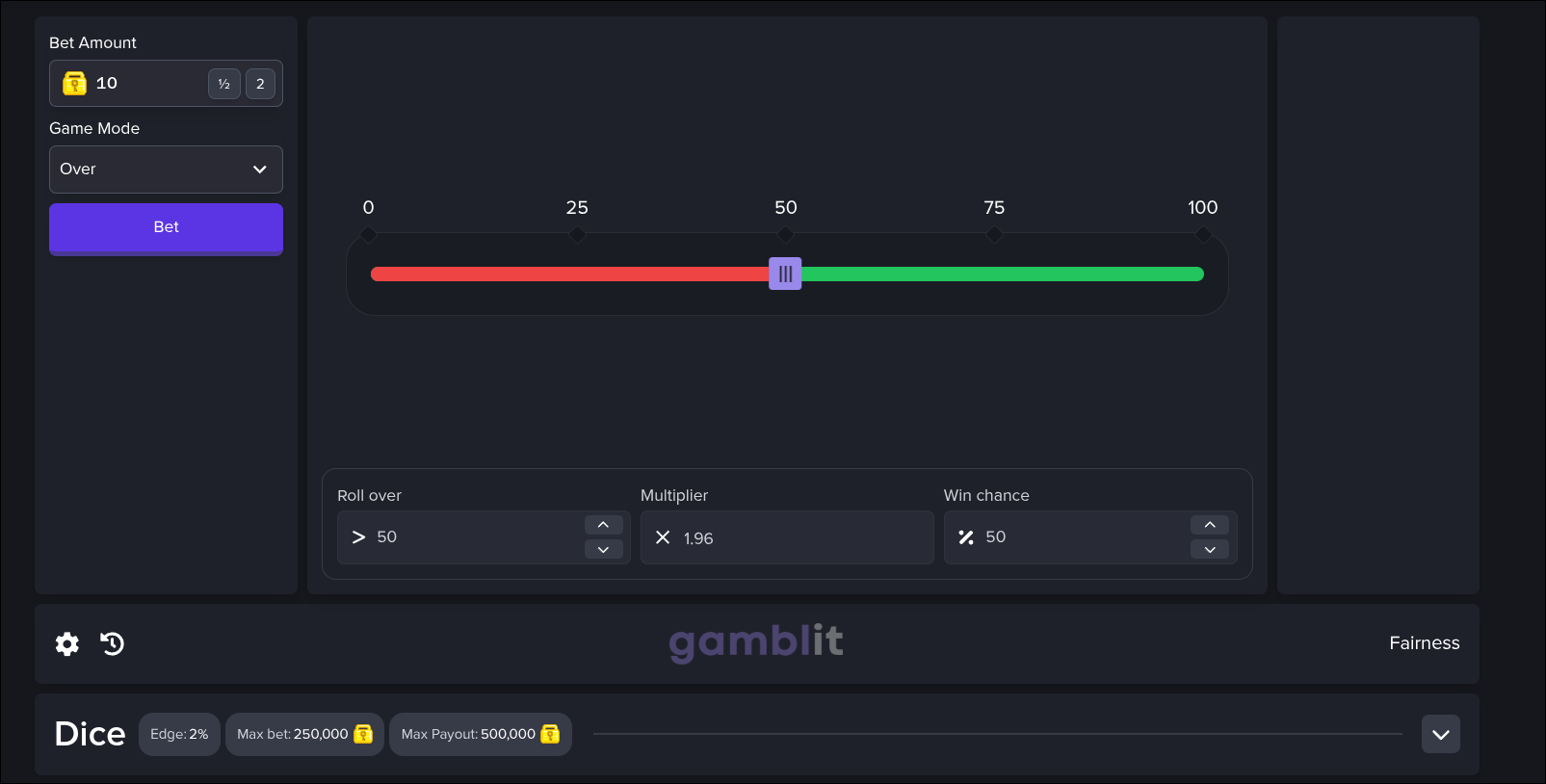
I built out a slick, hyper-fast version of the classic crypto Dice game for Gamblit. The whole concept here is risk control. Instead of just clicking “bet” and hoping for the best, players actually dial in their own odds. You set a target number anywhere from 0.00 to 99.99 and guess if the roll lands over or under it. Safer bets pay out peanuts; risky bets pay out big. It’s raw gambling math, and my goal was to make this the fastest, most fluid version of it on the market.
What I Built
- Total Control: The UI had to be dead simple. You drag a slider, and the win chance, multiplier, and potential payout update instantly. No lag, no weird layout shifts.
- Machine-Gun Betting: Some players want to fire off ten bets a second. The backend and frontend had to be tightly synced to handle rapid-fire rounds without choking.
- Provably Fair Mechanics: If you’re building a casino game, players have to trust it. I wired up a provably fair system so anyone can cryptographically verify that their roll was 100% random and untouched by the server.
Key Features
-
That Slider UI:
- It’s the heart of the game. Dragging it recalculates the “Roll Under” and “Roll Over” math in real-time. It feels great to use.
-
The Auto-Bettor:
- High-rollers love automation. I built a bot system where players can script their own Martingale strategies—like automatically doubling their bet on a loss or resetting on a win—and just let it run.
-
Zero-Latency Rolls:
- You click roll, you get the result. No artificial suspense animations taking up ten seconds of your time. Winnings hit the wallet immediately.
-
Provably Fair Validation:
- Every roll exposes its server seed and client seed hashes. If a player wants to audit a bad beat, the data is right there for them to verify.
The Stack
- Frontend: Vue.js. It’s reactive, lightweight, and keeps the slider math feeling buttery smooth.
- Backend: Go (Golang). When you have people running auto-bettors at 5 rounds a second, you need massive concurrency. Go didn’t even break a sweat.
- RNG Engine: Standard cryptographic hashing (SHA-256) mixing client and server seeds.
- Database: Postgres for the hard ledgers and transaction history, with Redis acting as an ultra-fast cache for live game states.
How It’s Doing
Dice is basically the heartbeat of Gamblit now. It draws in everyone from guys betting pennies to test strategies, all the way up to whales running insane automated scripts.
“The Dice game on Gamblit is my go-to. I love that I can control my exact risk on every single roll. I’ve set up a custom auto-betting strategy that just runs in the background, and it’s been working out great. It’s simple, fast, and I trust it because I can check the fairness of my rolls.”